10 Best Quentin Tarantino Characters, Ranked
From vengeful protagonists to silver-tongued villains, we analyze the greatest roles from the storied filmography of Quentin Tarantino.
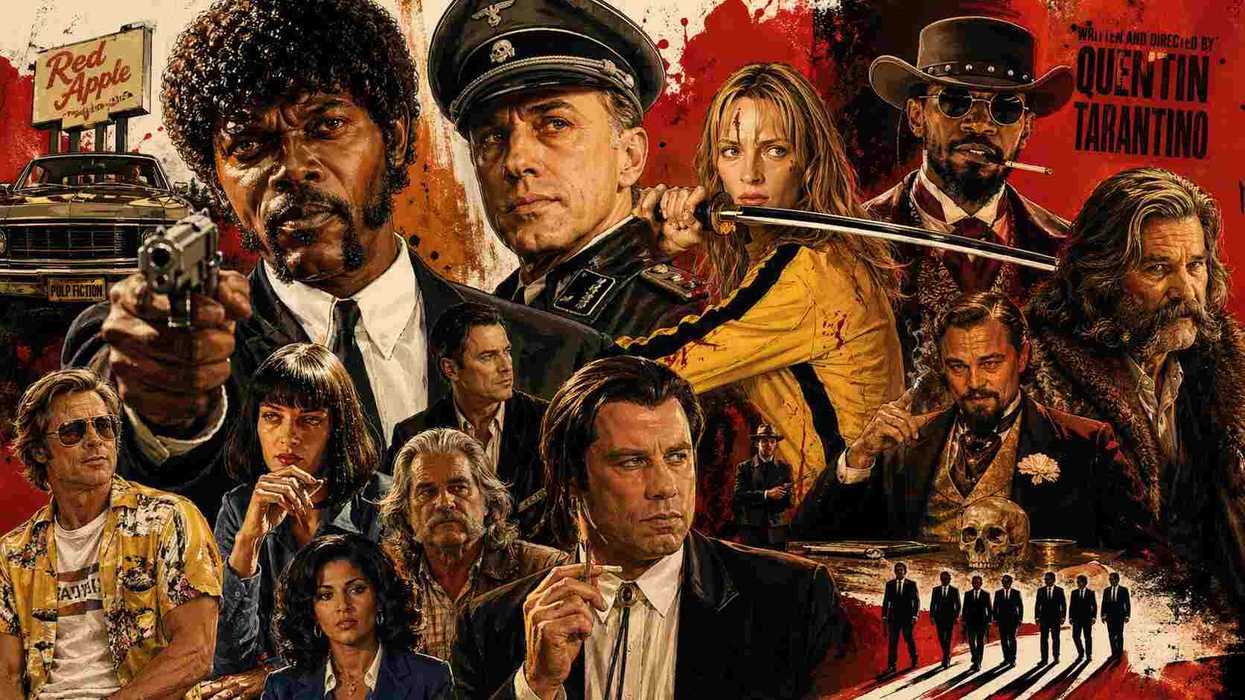
Best Quentin Tarantino Characters
An average, run-of-the-mill director (or a writer) uses characters as “disposable tools” that serve more or less only one purpose: to move the plot from point A to point B. You might as well call these tools placeholders.
But when directors have a more nuanced and visceral vision for the story, which is psychologically rich, emotionally grounded, internally driven, and most importantly, humanized, then these placeholders transform into people. Real people with messy internal lives, dysfunctional behavioral patterns, and even distinct, rhythmic vocabulary. They elevate from being just roles and become unique blueprints for human nature.
Quentin Tarantino’s legend is multifaceted. Unique stories, non-linear narratives, extended witty dialogue, highly stylized graphic violence, colorful language, and meticulous genre homage—all this contributes to it. His own eccentric (or may I say “bizarre”) personality is a big factor, too.
But the shining crown of his cinematic legacy is his array of characters. He doesn’t write them to be liked; he writes them to be watched. And the more closely you watch them, you find yourself untangling them thread by thread.
They are pretty talkative. You might even call them loudmouths. They think fast, often impulsively. And they are, almost always, carrying just enough damage to make their every decision feel personal and vibrant.
To be honest, “ranking” them is not a completely satisfying task. No matter how I rank them, I always feel like I am doing an injustice to those who are not at the top. So, I won’t call this list definitive. It’s subjective. That too, just for the moment. Because after a while, I am going to feel like reshuffling it.
But that’s exactly why it proves that these characters are truly something. They are people with agendas, blind spots, and a pulse that doesn’t depend on the plot to keep beating.
10 Most Compelling Tarantino Movie Characters
10. O-Ren Ishii (Kill Bill: Vol. 1 & 2, 2003–2004)
Portrayed by: Lucy Liu | Created/Written by: Quentin Tarantino
O-Ren Ishii is a character study that shows how trauma translates to absolute authority. Her rise from a pre-adolescent child who witnessed her parents’ murder to a cold-blooded head of the Tokyo Yakuza is a complete, eventful, and enormously tragic arc. She isn’t a villain just for the sake of it, like the Joker; she is a survivor who built such a solid fortress around her emotions that she lost touch with humanity. If you look at her, she is the epitome of Japanese elegance. She is never reckless, and her actions are never impulsive or chaotic. She operates with a strict code. But this is a facade—the fortress—that carefully hides her volatile history. And that’s what makes her a formidable but empathetic antagonist.
9. Calvin Candie (Django Unchained, 2012)
Portrayed by: Leonardo DiCaprio | Created/Written by: Quentin Tarantino
Some villains are not scary but unsettling and disturbing. Hitler never saw himself as cruel. He truly saw himself as a messiah. This extreme malevolence wrapped in delusion is what generates this unease. And that’s pretty much Calvin Candie for you. He represents the worst of the worst of the Antebellum South, but he sees himself as charming, refined, and sophisticated. And of course, racially superior. He doesn’t embody power; his power is performative. He is a repulsive intersection of extreme wealth and intellectual insecurity—and inferiority.
8. Mr. White (Larry Dimmick) (Reservoir Dogs, 1992)
Portrayed by: Harvey Keitel | Created/Written by: Quentin Tarantino
In his debut, Tarantino fills the screens with a conclave of criminals (made up of antisocial psychopaths, sociopaths, and paranoiacs), while Mr. White serves as a singular emotional anchor. He is “morally compromised” rather than a pure criminal—I mean, of course, he is, but there is motivation beyond just greed and malice. He has two key flaws that prove fatal: a) his misplaced paternal instinct and b) his old-school professional code in the world of undercover betrayals. They bind him to the reality of his situation and trigger his downfall. In this film, his undoing hurts the most because he goes from an elegant position of veteran authority to a man shattered by his own loyalty.
7. Bill (Kill Bill: Vol. 1 & 2, 2003/2004)
Portrayed by: David Carradine | Created/Written by: Quentin Tarantino
Bill is a walking oxymoron. He is charismatic and suave, but also murderous and brutal. He is intelligent and analytical but also jealous and possessive. He is stoic and calm but also a Machiavellian psychopath. Altruistic and, at the same time, cruel. He orchestrates a gruesome tragedy and views himself as its romantic lead. You cannot put a finger on what exactly his motivations are; most likely, they are a toxic mix of love and his need for control. He presents himself as deeply philosophical and poetic—and mind you, he has the flair for it. In the end, however, when he drops to the ground, he drops as a man who couldn’t handle the simple reality of being left behind.
6. Rick Dalton (Once Upon a Time in Hollywood, 2019)
Portrayed by: Leonardo DiCaprio | Created/Written by: Quentin Tarantino
To describe Rick in one sentence without any fluff: a walking mid-life crisis with a cigarette in one hand and a script in another. He may be a (fading) Western TV star, but you can relate to him because his struggle is with something that you and I are closely familiar with: being irrelevant. His character arc isn’t a zero-to-hero story; it’s simply a demonstration of how he finds peace in a changing industry. He is vulnerable, and that, coupled with his stuttering self-doubt, makes him incredibly human, and to be honest, kinda lovable.
5. Jackie Brown (Jackie Brown, 1997)
Portrayed by: Pam Grier | Created by: Elmore Leonard | Written by: Quentin Tarantino
Jackie is a middle-aged flight attendant, navigating a precarious life. All she has at her disposal are her street-smart intelligence, quiet and patient observation, and a drive to escape the dead end. In a way, she is not much different from a modern woman: tired of playing a second fiddle in the man’s world and harboring a strong desire for freedom and dignity. Oh, and yes, she drives the narrative by out-thinking every other player in her circle. If it means using their arrogance and greed against them, then be it.
4. Dr. King Schultz (Django Unchained, 2012)
Portrayed by: Christoph Waltz | Created/Written by: Quentin Tarantino
Schultz is a fascinating contradiction. He is a bounty hunter, but he abhors the institution of slavery. He is guided by strict principles, but those principles are not without their limits. He is undoubtedly charming and intelligent, and still, he fumbles when confronted with moral boundaries he cannot ignore. What he does isn’t always practical, but it’s always consistent with his beliefs. After surviving his entire, dangerous arc with commendable restraint and patience, he lets go in a vulnerable moment of pure, impulsive integrity and proves that even a man who kills for money can have an unbreakable soul.
3. The Bride / Beatrix Kiddo (Kill Bill: Vol. 1 & 2, 2003–2004)
Portrayed by: Uma Thurman | Created/Written by: Quentin Tarantino
Many of you might think the Bride, or Beatrix, should be in the top spot. After all, she could be the poster girl of the “Book of Tarantino Characters.” Well, in my opinion, any of the top three characters could be in the top spot. So that’s that. As for Beatrix, her journey is iconic for being a grueling physical and spiritual marathon, fueled by a singular purpose: revenge. While the world (conveniently) reveres the “tolerant” virtue of women, Beatrix shows the hard limit on that one. And oh boy, does she make a “blood-splattering” display of it! But underneath all that sheer power and grit, there is even a stronger woman who sheds her identity as an assassin to find her identity as a mother. Her transition from “The Bride” to “Beatrix” is truly one of the most satisfying and complete arcs in modern cinema.
2. Jules Winnfield (Pulp Fiction, 1994)
Portrayed by: Samuel L. Jackson | Created/Written by: Quentin Tarantino
Right in the middle of a working day, Jules, a hitman, has a spiritual epiphany and decides to act on it—obviously, proclaiming it with his signature loudmouth flair. At one end of his arc, he is a violent assassin who kills while reciting scripture as a theatrical tool, and on the other end, he is someone who actually tries to find truth within those same words. His arc is about a difficult choice and can be summarized into a simple phrase from the scripture he keeps repeating—“Be the shepherd.” And in the end, he does.
1. Colonel Hans Landa (Inglourious Basterds, 2009)
Portrayed by: Christoph Waltz | Created/Written by: Quentin Tarantino
Tarantino himself considers Colonel Hans Landa his best-written character, going so far as to claim he would have cancelled the film had he not found the perfect actor to play this “Jew Hunter.” And Landa is indeed one of the most terrifying villains. He is an intelligent detective/sadist/manipulator/opportunist, for whom the horrors of war are nothing but bargaining chips. He appears proud, flaunting his Nazi allegiance and all those medals and decorations, but in reality, he is aligned with no one but himself. Interestingly, despite his lack of soul, he has depth, and it comes from his brilliant, analytical, and erudite mind. I think he might be the worst (as in, most evil) antagonist in cinema, because he is always three steps ahead and driven by a bureaucratic, cold logic that feels disturbingly real.