Analyzing the ‘Reservoir Dogs’ "You Shoot Me in a Dream..." Threat That Sounds Like a Joke
Mr. White’s words, “You shoot me in a dream, you better wake up and apologize,” show how calm language can carry lethal authority.
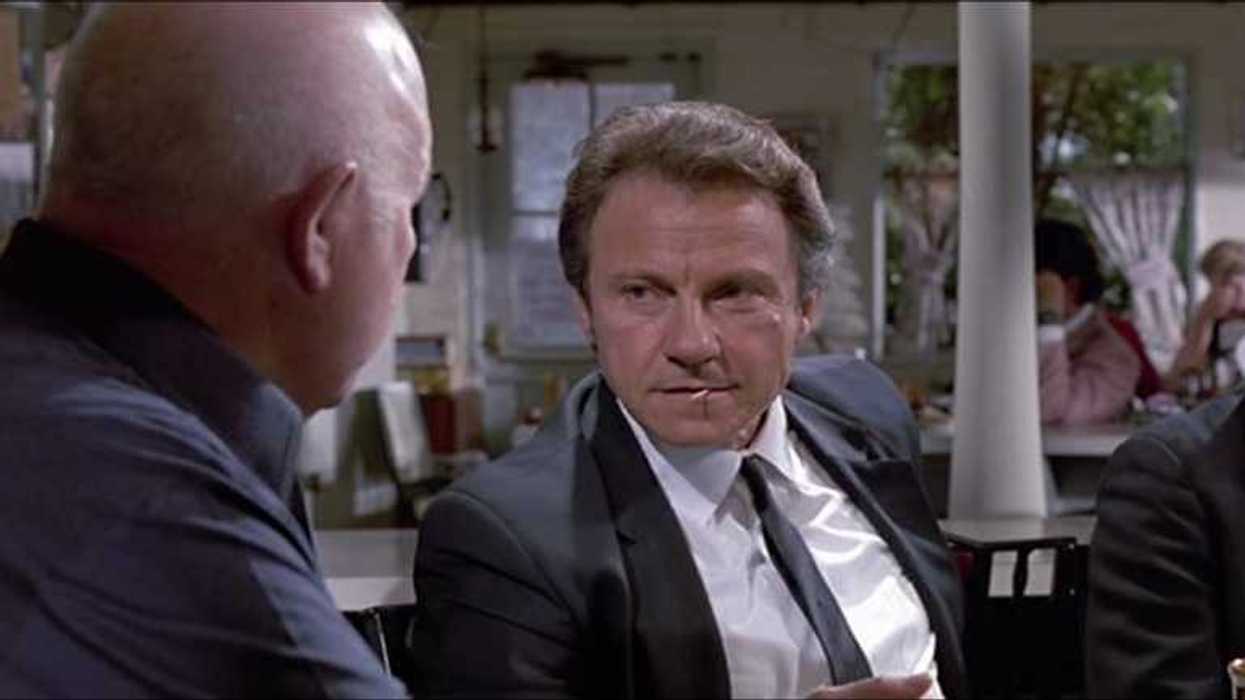
Reservoir Dogs (1992)
The scene is significant in the sense that it kicks off the movie’s narrative as well as Quentin Tarantino’s directorial career. It shows a group of men, including a career criminal, an ex-convict, a drug dealer, and others, having breakfast in a diner. Their motive is to rob a jewelry store later.
While they eat, they debate over various topics, such as what Madonna’s “Like a Virgin” is about, some random name in an address book, and the ethical dilemma of tipping. These trivial conversations serve to reveal each of their personality traits. Mr. Pink (Steve Buscemi) is self-serving, Mr. Blonde (Michael Madsen) is a sociopath, Mr. Brown (Quentin Tarantino) is crude and confident, and Mr. Orange (Tim Roth) might be a little bit of a snitch.
But the character that stands out the most is Mr. White (Harvey Keitel). When Mr. Blonde jokes about shooting Mr. White, Mr. White casually says, “Shit, you shoot me in a dream, you better wake up and apologize.”
That’s it! A fun banter response to a fun banter tease. And yet, it has trickled so deep into our collective memory that a blog is being written about it. Why exactly? There is no voice raised, no dramatic pause or tone, not even a momentary stare. Ostensibly, there is nothing that would make the line stand out, and yet, it does.
That may be because, even though it sounds like a passing comment, it carries the weight of a loaded sniper rifle. And the casual tone screams the certainty of consequences.
Mr. White
Mr. White has an emotional core and a strong sense of fairness and loyalty, even though he is a career criminal. During their debate about whether a waitress should be tipped, he speaks in her favor and pays the tip himself when Mr. Pink tries to rationalize not paying. But he is not driven by instincts. For him, loyalty and clarity are more important than survival and dominance. Every time he speaks, he establishes values and terms. He doesn’t have to engage in chest-thumping because his reputation does most of the work.
Why His Threat Sounds Like a Joke
Casual Language as a Power Move
In this line, there is not a single word that attracts any special attention. Neither a choice word nor a noteworthy phrasing. It contains no violent imagery. He even says it as a humdrum statement said matter-of-factly.
But this casualness works deceptively. It manipulates the listener into keeping his guard down; it practically disarms him, while it makes the threat sharper. The words are conversational and polite, but the message couldn’t be clearer: respect is non-negotiable, even hypothetically.
Harvey Keitel’s Delivery
Keitel maintains the deceptive politeness of the character intact. There is no smirk, no pause, no tonal fluctuations. The delivery is straightforward, unembellished, with just a tinge of playfulness. Keitel bears the character’s credibility perfectly, thereby making the line sound like a rule that has existed for a long time, and its compliance is obvious. No argument. The lack of emotional emphasis tells us that this is nothing new to him. He has enforced this rule before.
What the Line Says About Loyalty and Violence
Violence as a Boundary, Not an Outburst
In Reservoir Dogs, violence is neither mandatory nor impulsive. But it’s conditional. It’s bound by a strict code of conduct. Betrayal, real or imagined, counts as a violation of that code. Responding to betrayal with violence may not be the first option, but it damn sure will be the last one.
Early Tarantino and the Dialogue-Led Authority
Dialogue in Tarantino movies has always been one of their leading selling points. And this line, here, signals a “this is where it all began” moment. The genesis of the Tarantino swagger. Without any explanations or flashbacks, it draws out all the core messages and character attributes that we need to know. This is how Tarantino tells us that authority can stand without a spectacle, as long as it has conviction and precision.
Parting Words
The most brilliant part of the line is, of course, how it balances humor with a very real threat, but also the fact that it refuses to perform. It sounds realistic and reasonable, and yet it makes its weighty presence felt. That’s what makes it unsettling.
It’s a reminder that, in the crime world, your reputation is your highest currency. You can either exhaust an entire magazine of ammunition or say a single sentence to put a point across; the choice is yours. But whatever you choose, it will say a lot about you.
- Everyone Misunderstands the Hand-Drawn Joke in 'Pulp Fiction' ›
- These 11 Characters Stole the Entire Movie With Just One Scene ›
- What’s in Pulp Fiction’s Briefcase? Nothing and Everything ›
- The Meaning Behind Pulp Fiction’s “Royale with Cheese” ›
- Unpacking the Dark Legacy Behind the Gold Watch in 'Pulp Fiction' ›
- How Pulp Fiction Hacks the Three-Act Structure ›
- 10 Iconic Quotes from Quentin Tarantino Movies ›
- The Improvised Scene That Defined ‘Reservoir Dogs’ ›
- ‘Reservoir Dogs’: The Slow-Mo Walk That Defined Cool ›
- What Made the Opening Scene of 'Reservoir Dogs' Iconic? ›
- The Perfect Villain: How Hans Landa Turned a Simple Goodbye Into a Death Sentence ›
- Striding into Legend: 10 Most Iconic Walks in Cinema History ›
- All the Movie and Pop Culture References in Tarantino's Reservoir Dogs | No Film School ›