The Meaning of “Print the Legend” in ‘Liberty Valance’
The line, “When the legend becomes fact, print the legend,” explains why legends endure even when the truth tells a different story.
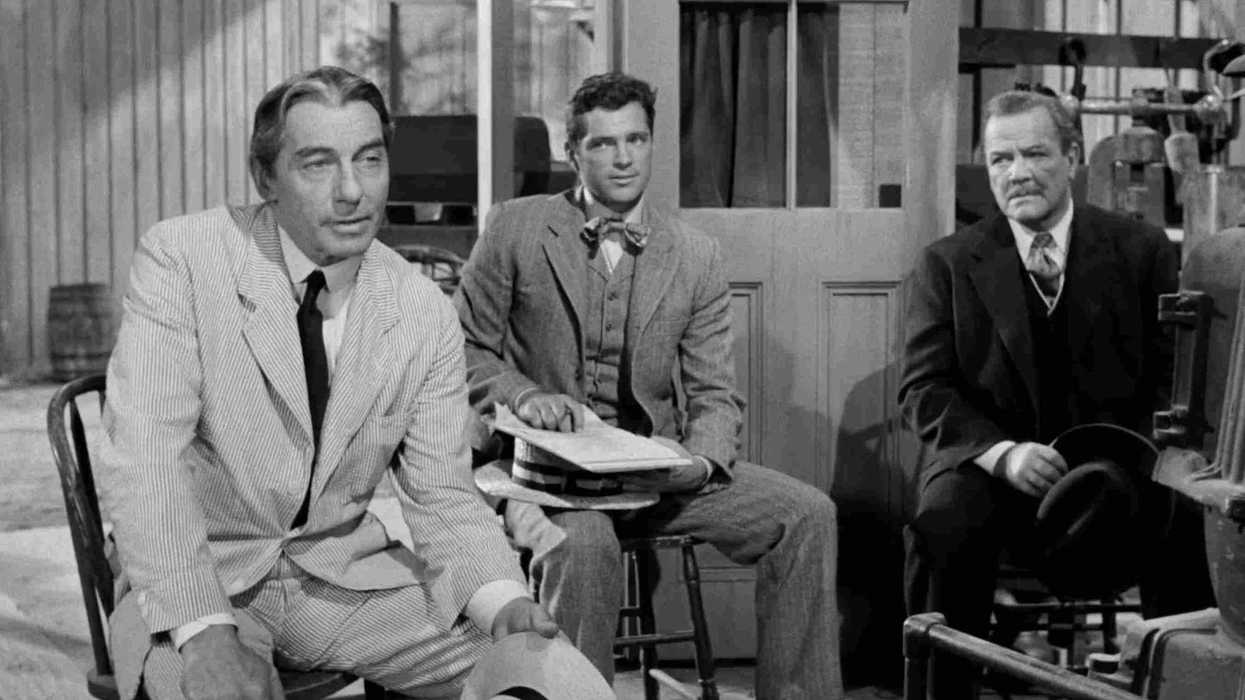
‘The Man Who Shot Liberty Valance’ (1962)
The film is essentially a Western, a revisionist one, but toward the end, a line is spoken that changes its whole vibe.
“This is the West, sir. When the legend becomes fact, print the legend.”
It comes neither from James Stewart nor John Wayne, the film’s stars; it comes from a minor (tactically) supporting character. He is a journalist, someone who regularly deals with facts and legends, truths and fabrications. He has just come upon a truth but decides it’s better if it remains hidden.
At this very moment, the film stops being just a Western and becomes a philosophical quest into the morality of deception.
This line is a study of our simplistic minds—how we create heroes, strive for a simple but appealing story, and turn complicated events into clean legends. If you can read between the lines, this particular line says that the American West, or perhaps America itself, wasn’t shaped by facts alone; it was shaped by the stories people chose to believe.
Context
The story starts near the end of the 19th century. U.S. Senator Ransom “Ranse” Stoddard (James Stewart) travels to a small frontier town of Shinbone to attend the funeral of Tom Doniphon (John Wayne), an ordinary, poor rancher. When a reporter asks why a senator would attend such an insignificant event, Ranse tells a story that happened 25 years earlier.
Ranse, a young lawyer, arrives in the then-unincorporated territory to establish his practice. But as soon as he arrives, he is robbed and beaten by an infamous outlaw, Liberty Valance (Lee Marvin), and his gang. Tom and his girlfriend, Hallie (Vera Miles), tend to his wounds. Tom informs him that wealthy cattle barons want to preserve the open range, maintain control over the territory, and are opposed to statehood. Liberty acts as their violent enforcer against anyone who promotes civilization and law, such as Ranse himself. And since the local marshal is too cowardly to act, Liberty has been freely terrorizing the town. Ranse vows to deal with Liberty through legal means.
However, a while later, when Liberty vandalizes a local newspaper office and severely injures its editor for reporting on his crimes, Ranse is enraged and arms himself, intent on killing him. Although Liberty overpowers him at first, Ranse indeed manages to kill him. Later, when Hallie is tending to his wounds, Tom notices affection between them. Distraught, he sets his house, which he was building for Hallie and himself, on fire and attempts to kill himself in it but is saved by his handyman.
At the territorial convention, Ranse is nominated as a delegate to Congress, but his nomination is objected to by the group of cattle barons, who are upset that Ranse foiled their plans. They accuse him of building a career from murdering a man. Ranse withdraws his nomination on ethical grounds. Tom arrives and explains to Ranse that it was he, not Ranse, who killed Liberty. He knew Liberty, a seasoned killer, would be too strong for Ranse to take on, so he followed him, and it was his shot, not Ranse’s, that killed Liberty. He urges Ranse to accept the nomination and do the good work, so Hallie will have a civilised world to live in.
Back to the present: It is revealed that, since then, Ranse has come a long way and achieved significant political success, to the point of being a likely candidate for vice president—all this built on the reputation of being the man who killed Liberty Valance.
The reporter, Maxwell Scott (Carleton Young), however, opines that this true story will make a hole in Ranse’s legacy and tears up the reporter’s notes. When Ranse asks why he won’t report it, he replies, “This is the West, sir. When the legend becomes fact, print the legend.”
The Editorial Choice of Maxwell Scott
Tearing Up the Notes
In usual circumstances, if a high-profile senator “confesses” the hidden truth of his life, a regular scoop-hungry journalist would jump on it and start drafting a career-boosting “breaking news” piece. Maxwell Scott, however, takes a road less traveled—the road of thoughtfulness. He tears up and burns the evidence that could have proved that Ranse’s heroism, which gave him a solid footing in the public eye, was technically someone else’s heroism.
The keyword here is “technically.” In that moment, Ranse had armed up, he had walked up to the evil, dangerous man, he had aimed at him, and he had shot at him. The only thing that fell short was Ranse’s gunmanship. But Ranse was a lawyer, an activist; he wasn’t a gunslinger. Plus, the reason why he had risked his life wasn’t personal. He had done it to avenge a random person’s injustice. If anything, it speaks volumes about Ranse’s character.
And that’s what Scott sees here. He realises that the public had already bought into the image of a law-abiding statesman who risked his life for others, for a larger good, and he stood his ground. Correcting the record wouldn’t achieve anything but instead diminish a necessary symbol of progress.
Choosing the Better Story
Scott is aware that he lives in a world that thrives on unlikely heroism, especially if it is from someone who is a political leader. That’s why we are intrigued and impressed by leaders who excel at sports or martial arts, or those who go horseback riding bare-chested. (Ahem!) So, a lawyer and a potential vice-president (maybe a president someday) winning a gunfight is tremendously inspiring for common people. This public intrigue is actually worth it if that leader is a decent, intelligent person with integrity. After all, Ranse did confess the potentially image-sabotaging truth at a very precipitous point in his career.
So, Scott prioritizes perpetuating the “legend” of a gunslinging senator over the “reality” of a hidden marksman doing the dirty work. He prioritizes the needs of a budding civilization over the accuracy (and circulation) of his own newspaper.
Transitioning from Outlaws to Order
The Death of the Old West
In this story, Tom, a gun-wielding man of violence, is the representative of the Old West. When the narrative credits the New West figure, Ranse, with the kill, it quietly kills the era of lawlessness in the shadows. Yes, it’s false; it’s a fabrication of the facts, but it’s also the necessity of the moment.
Creating National Identity
The pages in the book of history are glued together with legends. That’s especially true in the context of our nation and our society as a whole. Ranse, or Senator Stoddard, is a symbol of a just, functional system. The knowledge that this symbol, this system, was built on heroism feels even more inspiring. But when you say that it was bought with a backshot, not so much. The whole inspiring element falls apart.
When Scott chooses to print the legend, instead of the fact, he ensures that he sends a clear message: the foundation of America was built on a “clean” victory. He turns a messy homicide into a foundational triumph of good over evil.
Conclusion
What’s history really? At its very core, it’s a collection of stories we have “chosen” to believe. The Man Who Shot Liberty Valance proves that, if we want to keep our faith in our past intact, we must know that truth is a luxury we cannot afford. And legendary figures, definitely not.
We make a big deal out of truth, fact, and honesty. But when it comes to our history books (or movie screens), we hide the uncomfortable truth and fill them with heroes. And, at such a time, it’s just easier to admit that the legend is more useful than the truth.
- 10 Best Westerns of the 1970s: Ranked ›
- The ‘Dirty Harry’ Line That Made Clint Eastwood Untouchable ›
- Why Clint Eastwood Cut the Original Final Scene of ‘Unforgiven’ ›
- The Line That Made Clint Eastwood a Legend ›
- The Coldest Line Clint Eastwood Ever Delivered in ‘A Fistful of Dollars’ ›
- 12 Lines That Made Clint Eastwood a Legend ›